Sunday, 14 August 2011

EXPERIMENT No.5 The Capacitor


The Capacitor

The capacitor stores electric charge.


A capacitor consists of two metal plates very close together, separated by an insulator. When connected to a battery or power source electrons flow into the negative plates and charge up the capacitor. The charge remains there when the battery is removed. The charge stored depends on the “size” or capacitance of the capacitor, which is measured on Farads (F).

Types of capacitor:

Non-electrolytic capacitor

·          Fairly small capacitance - normally about10pF to 1mF
·          No polarity requirements - they can be inserted either way into a circuit.
·          Can take a fairly high voltage.
Variable capacitor

·          Adjustable capacitor by turning a knob - similar to variable resistors.
·          The maximum capacitance available is about 200pF.
·          Used in radios.
Electrolytic capacitor


·          Large capacitances - 1mF to 50000mF
·          Warning: These must be corrected the right way round (polarity) or they can explode - the white terminal on the diagram above signifies positive.
·          Black stripe with “-“ shows which terminal is the negative (usually the short one)
·          Low voltage rating – from 25 ~ 100V DC
·          They have a significant leakage current - this means that they will lose the charge stored over time.
Tantalum capacitor

·          These have the same properties as the Electrolytic capacitor, but they are physically smaller & have lower leakage. As a result, though, they are more expensive.


Identifying Capacitor “Size”

If the Farad “size” is not printed on the capacitor, you may find an EIA code listed. Use the table below to figure out the capacitance


μF
nF
pF
EIA Code
0.00001*
0.01
10
100
0.0001*
0.1
100
101
0.001
1.0 (1n0)
1,000
102
0.01
10
10,000*
103
0.1
100
100,000*
104
1.0
1000*
1,000,00*
105
10.0
10,000*
10,000,00*
106

* Values with asterisk are not usually expressed in this form


RC Time Delay or “Charging Time”

Capacitors take time to charge. It doesn’t happen instantly. The charge time is dependent on the resistor in the circuit and the size of the capacitor. And it is expressed in the equation: R x C x 5 = T.  This is the time it takes to charge up to the applied voltage.

For example, 1,000,000 Ω x 0.000001 F x 5 = 5 seconds to charge to applied voltage. This can also be expressed as 1 MΩ x 1 μF x 5 = 5 seconds.

Capacitors are often used for timing when events take place. And often the voltage only has to get up to about 2/3 the applied voltage, and this happens at about 1/5 the time of their charging. So this is why the 5 is built into the equation. The concept of “time constants” is used here, where whatever the time it takes for a capacitor to build up to the full charge, it takes about 1/5 of that time to build up close to 2/3 of the charge. So you can divide the charge time into 5 segments, and the first time segment is often the time you are interested in.


Practice watching the capacitors charge up in the exercise below.


Fig 8-Capacitor Charging Circuit

Components: 1 x resistor, 1 x capacitor. 1 x pushbutton N/O switch.

Exercise: First, calculate how much time it would take to charge up the capacitor. Then, connect the circuit as shown above. Measure the time taken by the capacitor to reach the applied voltage on an oscilloscope. Fill in the chart below. Also draw the observed waveforms in the graphs below, filling the details on each one.


Note: you will need to adjust the time base to enable you to observe the pattern.


Circuit number
Capacitance (uF)
Resistance (KΩ)
Calculated Time (ms)
Observed Time (ms)
1
100
1
500ms
500ms
2
100
0.1
50ms
50ms
3
100
0.47
235ms
235ms
4
330
1
1650ms
2000ms


Label the axis of each graph:


Circuit 1:


Capacitance 100mF                     Resistance 1000


File written by Adobe Photoshop® 4.0

Circuit 2:


Capacitance 100mF                      Resistance 100


File written by Adobe Photoshop® 4.0

Circuit 3:


Capacitance 100mF                     Resistance 470


File written by Adobe Photoshop® 4.0

Circuit 4:


Capacitance 330mF                      Resistance 1000


How does changes in the resistor affect the charging time?

The charge time of the capacitor depends on its size and the size of the resistor in the circuit. The lower the resistance of the resistor, for example 100W the faster it would take to charge the capacitor. A resistor with a higher resistance like 1000W will take a longer time to charge then a 100W resistor using the same capacitor because the resistor limits the current flow which charges the capacitor at a slower rate.


How does changes in the capacitor affect the charging time?
Capacitors take time to charge up depending on the value of the resistor and size of the capacitor. A 330mf capacitor with a 1kW resistor will take a longer time to charge than a 100mf capacitor and same size resistor because the capacitor is determined by the size of the plates, the distance between them and the type of dielectric material used.


EXPERIMENTNo.4


EXPERIMENT No. 4


Components: 1 x resistors, 1 x 5V1 400mW Zener diode, 1X Diode1N4007 .

Exercise: Obtain a breadboard, suitable components from your tutor and build the following circuit.
                Vs=10 & 15v, R=1K ohms


                                                                                    Fig 7

                                    10 Volts                                                           15 Volts

Volt drop V1:   4.62v                                                               4.77v

Volt drop V2:   0.67v                                                               0.67v

Volt drop V3:   5.29v                                                               5.44v

Volt drop V4:   5.24v                                                               9.68v

Calculated current A:                                                           I = V/R = 15/1000 = 0.015A
I = V/R = 10/1000 = 0.01A


Describe what is happening and why you are getting these readings:

v1, v2 and v3 show similar readings between 10 and 15 volts. V1 is the zener voltage needed to move electrons through the diode to turn it on. V2 shows the voltage required to move electrons through the diode boundary layer to allow electric charge to flow. V3 is the zener voltage plus the voltage to turn the diode on. V4 is the voltage being consumed by the resistor. The voltage drop across the 1kohm resistor for the Vs of 15v is the only difference. This is because there is more Vs so the resistor has to consume more volts to add up the total voltage supply because this is a series circuit. The current value stays the same through out the circuit at 0.01A at 10v and 0.015A at 15v.  

EXPERIMENT No.3 Zener Diode


EXPERIMENT No. 3


Components: 2 x resistors, 1 x 5V1 400mW Zener diode (ZD).

Exercise: Obtain a breadboard, suitable components from your tutor and build the following circuit.

Fig 6


For R= 100Ω and RL= 100Ω, Vs= 12 V.


What is the value of Vz?

Vz = 5v

Vary Vs from 10V to 15 V

What is the value of Vz?

Vz = 5.06v

Explain what is happening here

At 10v the value of Vz is 4.77v and as I increase the Vs to 15v the value of Vz is 5.06v. The input Vs to the Zener diode isnt stable but the zener diode keeps a fixed voltage output. It breaks down 15v to 5v.

What could this circuit be used for?

This circuit could be used for powering a device connected to a 12v supply that requires less voltage say 5v and keep it fixed. 


Reverse the polarity of the zener diode.

What is the value of Vz? Make a short comment why you had that reading.


The value of Vz is 0.7V in the forward Bias because it acts as normal diode in this direction which requires less voltage to turn it on. 

EXPERIMENT No.2 DIODES


EXPERIMENT No. 2


DIODES


Fig 3 - Diode Symbol & Physical component


Fig 4 – Diode symbol and P.N. junction


A diode has the characteristics of:
·       An insulator when current tries to flow in one direction.
·       A conductor when current flows in the other direction.
  
Components: 1 x diode, 1 x LED

Exercise: Using a multimeter, identify the anode and cathode of the diode and the LED.


Voltage drop in forward Biased Direction.
Voltage drop in reverse biased direction
LED
1.784v
0v
Diode
0.568v
0v


Explain how you could identify the cathode without a multimeter

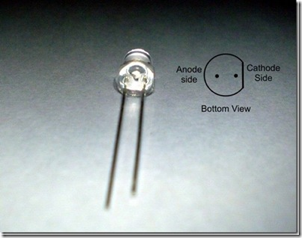
To identify the cathode side of a LED without a multimeter look on one side and it should be flat. The flat side identifies the cathode. This is a good way to identify the cathode side because the leads could be cut. The anode lead is longer than the cathode. Below is picture I saved of the internet showing an LED and its flat side.


(Refference) http://elecrom.wordpress.com/2008/03/02/anode-and-cathode-of-led/

On a normal Diode the grey band represents the cathode side. The anode lead is longer than the cathode. Below is a picture showing a diode and its grey band showing the cathode side.


(Reference) http://camhardyreidttec4841.blogspot.com/2011/05/diodes.html

Table 1: Data sheet of 1N4007 is as follows


Absolute Maximum Ratings, TA = 25OC
Symbol
Parameter
Value
Units
IO
Average rectified current @ TA = 75oC
1.0
A
PD
Total device dissipation
Derate above 25oC
2.5
20
W
mW/OC
Thermal resistance, Junction to Ambient
50
OC/W
Storage Temperature Range
-55 to + 175
OC
Operating Temperature Range
-55 to + 150
OC
VRRM  (PIV)
Peak repetitive reverse voltage
1000
V

Components: 1 x resistor, 1 x diode. 1 x LED

Exercise: For Vs=5V, R= 1KΩ, D= 1N4007 build the following circuit on a breadboard.

Fig 5


Calculate first the value of current flowing through the diode, now measure and check your answer?
Show your working

Calculated                                                                          Measured

I = V/R = 5 – 0.6 = 4.4/1000W = 4.4mA                           4.4mA                                                 


Is the reading as you expected; explain why or why not?

The reading is as I expected because I calculated the current using ohms law and then I measured the current flow with a meter and compared answers. 

Calculate the voltage drop across the diode, now measure and check your answer?

Calculated                                                                          Measured

V = I X R = 4.4 X 1000 = 4.4mA                                         0.6VD
VD = Vs – V1 = 5 – 4.4 = 0.6v                                                                                  

Using the data sheet given in Table 1 above,

What is the maximum value of the current that can flow through the given diode?

The average rectified current that can flow through the given diode is 1.0A @ 75°C

For R = 1KΩ.  What is the maximum value of Vs so that the diode operates in a safe region?

The maximum value of Vs so that the diode operates in a safe region is 1000 V.

Replace the diode by an LED & calculate the current, then measure and check your answer?


Calculated                                                                          Measured
I = V/R = 5 – 1.8 = 3.2 / 1000 = 0.0032A                           3.2mA

What do you observe? Explain briefly.

Looking at the LED and Diode, the LED requires a higher potential difference to move electrons through the boundary layer and turn it on than the Diode. electric charge flows through the Diode at a less voltage to open the gate therefore more electrons can flow freely.